
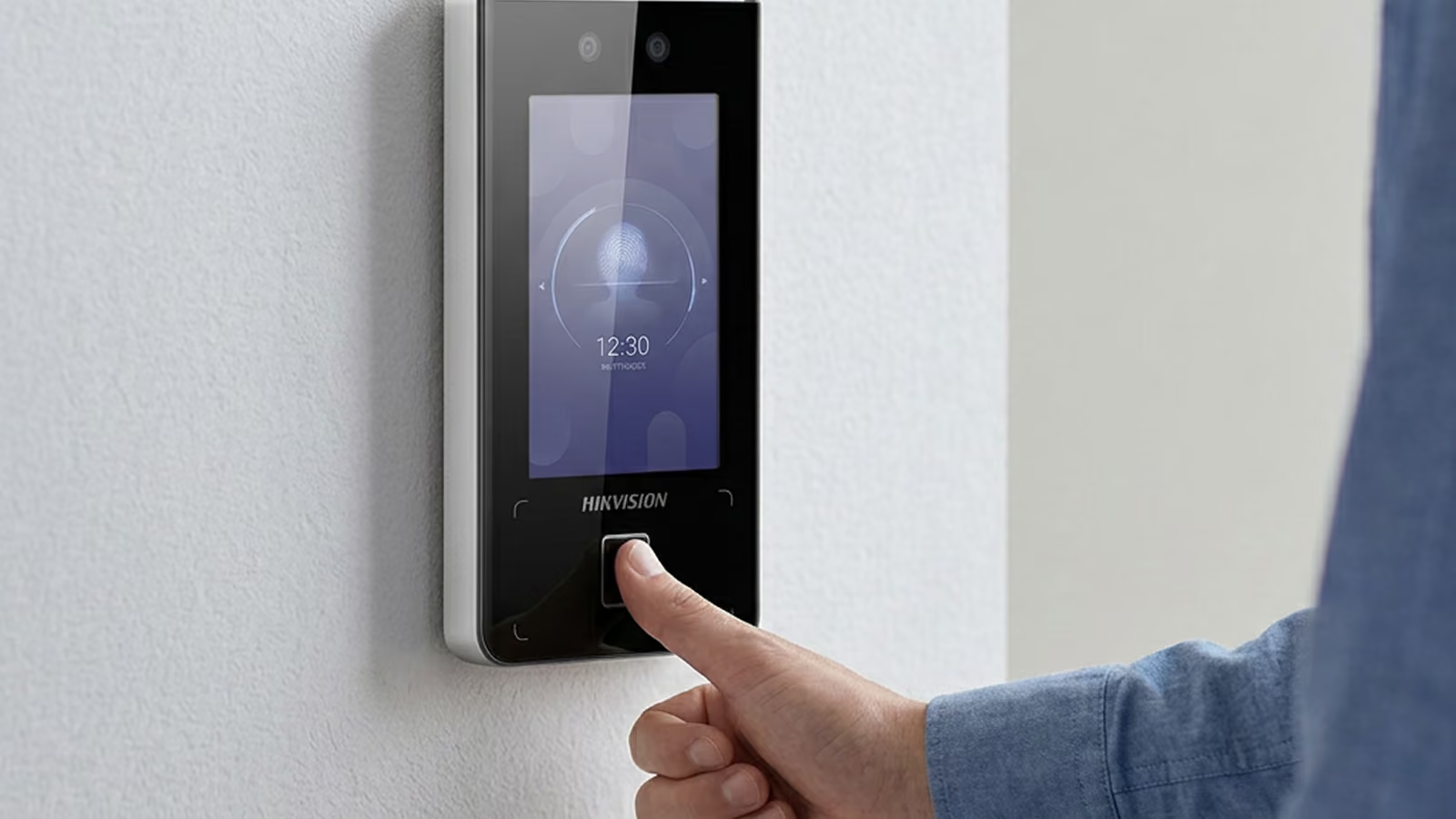


For mandatory working time recording in Belgium from 2027, no specific time clock system is required: a badge, a mobile app, software or simply recording exceptions to the schedule are all acceptable, as long as the system measures the time actually worked in an objective and reliable way. The right choice depends mainly on where your teams work.
This guide compares the four main time clock systems, their limits (including GDPR for biometrics) and helps you choose, team by team, before the 1 April 2027 deadline.
Key points
- Free choice: the Minister of Employment confirmed that no method or technology will be imposed.
- Legal test: an objective and reliable system that establishes the daily and weekly working time actually performed.
- Schedule exceptions: recording only deviations from the schedule may be enough, if the result reflects the real hours.
- Biometrics: fingerprint or facial recognition does away with lost badges and buddy punching. It is only an option if it complies with the GDPR: a valid legal basis (employee consent is rarely enough), a data protection impact assessment and a non-biometric alternative.
- Status: the law has not been voted yet at the time of writing; 1 April 2027 remains the date to prepare for.
Do you need a time clock system to comply in 2027?
No specific device is required. On 29 April 2026, Minister of Employment David Clarinval told the Chamber that the future law would not impose any form or technology. According to the Partena Professional FAQ (in French), recording can be done with software, a badge, a mobile app or any other suitable system.
What matters is the result: being able to determine, for each worker, the daily and weekly working time actually performed. We cover the timeline and who is affected in our guide to mandatory time tracking in 2027.
Where does the law stand?
The National Labour Council issued a divided opinion on the preliminary draft law on 30 September 2026 (opinion no. 2.499). The file is back with the government, which still has to table a final bill in the Chamber. The 1 January and 1 April 2027 dates therefore remain targets, to be confirmed.
The 4 time clock systems compared
Here are the possible options, from the most hardware-based to the lightest:
The wall-mounted time clock or badge terminal
The worker swipes a badge or card at a fixed terminal at the entrance of the workshop, warehouse or office. It is simple and fast, but everyone has to go through the same place. Plan for lost badges and the risk of one colleague clocking in for another.
The mobile time clock app
The worker clocks in and out from their smartphone, wherever they are. This is the best fit for technicians, construction crews and anyone who does not start the day at a fixed location. If you enable geolocation, inform your workers clearly and limit it to what is necessary.
Recording exceptions to the schedule
The schedule communicated in advance is the baseline, and only deviations are recorded: late arrival, overtime, early departure, longer break. This is light for fixed hours. According to the Partena Professional FAQ (in French), the schedule and the recorded deviations must together accurately reflect the time actually worked.
Where and how should deviations be recorded? In the system of your choice, as long as each deviation can be found per worker and per day. For each deviation, record at least:
- the worker and the date;
- the type of deviation (late arrival, overtime, early departure, break);
- the actual start or end time, or the length of the deviation;
- who recorded or approved it, and when.
Record the deviation on the same day, ideally by the worker themselves, rather than rebuilding the week afterwards: this is what makes the data reliable in an inspection or a dispute.
Is a paper sheet enough? In principle, yes: no technology is imposed and recording does not have to be electronic. But paper sheets get lost, are filled in late and have to be retyped for payroll, while the data will probably have to be kept for five years. An app is not mandatory, but it timestamps every entry and keeps the history of corrections.
The risks if deviations are recorded badly. If the published schedule does not match the hours actually worked, your system is no longer objective or reliable, and you will not be able to prove the hours if a claim is made. In 2020, the Brussels Labour Court ordered an employer with no recording system to pay 34 hours of overtime claimed by a worker. The penalties specific to the new obligation are not yet known.
The biometric time clock
Fingerprint or facial recognition is fast and does away with lost or shared badges. But it involves biometric data, a category of sensitive data that the GDPR prohibits processing in principle, unless an exception applies.
Is the employee's consent enough? Rarely. In an employment relationship, consent is only valid if the employee can refuse without any consequence. The Belgian Data Protection Authority made this clear in a decision summarised by PwC Legal: an employer relied on its employees' consent for fingerprint time recording, while time recording was mandatory in the company. The DPA found that consent was not freely given, considered that a badge would have been enough and noted that no impact assessment had been carried out. Fine: €45,000.
If you are considering biometrics, these are the conditions to meet:
- offer it as an option, never as an obligation;
- provide an equivalent alternative (badge, code, app) to those who refuse, with no disadvantage;
- carry out a data protection impact assessment (DPIA) before rollout;
- be able to show that a less intrusive method is not enough for your purpose;
- inform employees clearly and consult their representatives.
Properly managed, it remains a possible option. For simple time recording, however, a badge or an app achieves the same result with far fewer formalities.
Which time clock system for which team?
In most SMEs, the right answer is a mix. One single tool should still centralise all the data, otherwise payroll becomes a headache.
- Office, workshop or warehouse teams: badge terminal or app on a shared device.
- Mobile technicians and fitters: mobile app, ideally linked to jobs. See our guide to choosing field service management software.
- Construction workers: mobile app, together with site attendance declarations. On construction sites, real-time IN and OUT registration via Check In and Out at Work becomes mandatory on 1 April 2027: read our article on Check-in@Work 2027 on construction sites.
- Fixed, stable hours: recording exceptions to the schedule.
If your workers fall under construction, also check your sector's rules in our guide to Joint Committee 124.
Badge, app or both?
In a free demo, we show you how to combine clock-in methods for each of your teams.
Criteria for choosing your time clock or software
- Reliability: hours are entered at the time, by the worker, and every correction leaves a trace.
- Fit for the field: the system works where your teams actually work (site, customer, road).
- Link with the schedule: gaps between planned and actual hours show up without recalculation.
- Payroll export: data goes to your social secretariat without double entry.
- Retention: a five-year period is being discussed; choose a tool that archives and retrieves data easily.
- GDPR and consultation: inform workers, consult your employee bodies and update the work rules.
How T-Report handles your teams' time recording
T-Report is Belgian scheduling and time tracking software built for field teams. You combine clock-in methods by team:
- the mobile app for the field;
- a time clock for a fixed location;
- the smartwatch to clock in without taking out a phone;
- the Scheduling & time tracking module, which puts planned and actual hours side by side.
The subscription starts at €10 per user per month.
This article is for information only and does not constitute legal advice. It will be updated once the law is voted.

Frequently asked questions about choosing a time clock system
Is a time clock mandatory in Belgium in 2027?
No. No method is imposed: a badge, mobile app, software or recording exceptions to the schedule are acceptable, as long as the system measures the time worked objectively and reliably.
Can I use a fingerprint time clock?
Yes, with care. Employee consent is only valid if they can refuse without consequence: provide an alternative (badge, app), an impact assessment and clear information. In 2024, the Belgian DPA fined an employer €45,000 because consent was not freely given.
Which time clock system suits technicians on the road?
A mobile app, because they do not pass through a fixed point. Ideally it is linked to the schedule and jobs to avoid double entry.
Is recording only exceptions to the schedule enough?
Yes, if a schedule is communicated in advance and all deviations (late arrivals, overtime, early departures) are recorded. A schedule that does not reflect the real hours is not enough.
How long must time records be kept?
The period has not yet been set by law. Five years, as for the main social documents, is the period most often mentioned.
Other articles you might like.


Ready to save hours every week?
We will visit you in person for free to show you how T-Report could integrate into your business.